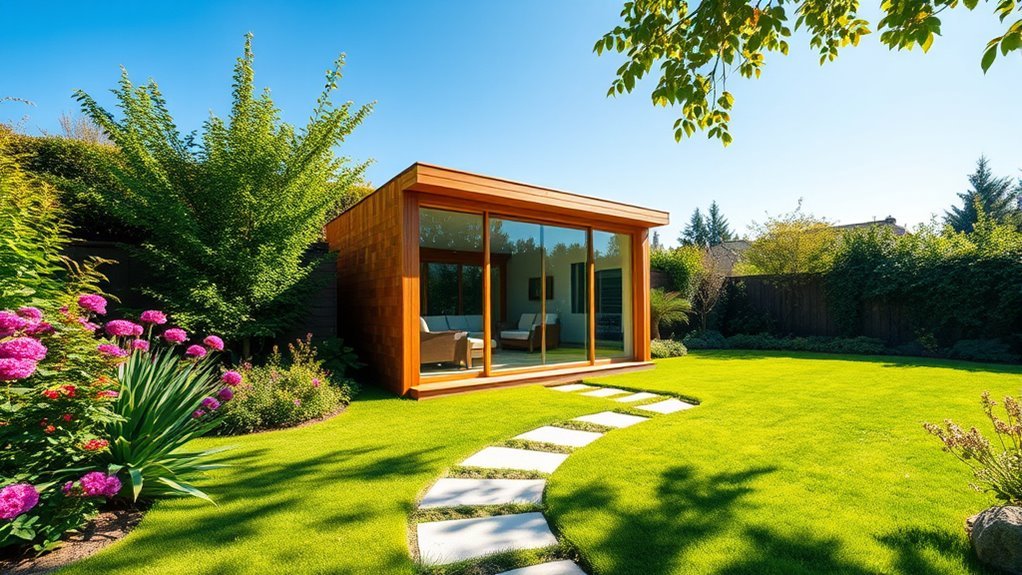
Do I Need Planning Permission for a Garden Room?
You need planning permission for a garden room if it includes sleeping, cooking, or bathing facilities, exceeds 30 square meters, or stands over 3 meters tall near a boundary.
It’s also required if you’re in a designated area like a National Park or plan to use the space for business.
Otherwise, you can usually build a single-storey garden room within specific size and height limits without permission.
Keep these basics in mind, and you’ll soon understand the full rules around garden rooms.
It’s all about knowing when you need permission and when you don’t, so you can enjoy your new space stress-free.
Key Takeaways
- Planning permission is needed if the garden room has sleeping, cooking, or bathing facilities.
- Permission is also required if the structure exceeds 30 square meters or is taller than 3 meters near boundaries.
- If your garden room is in National Parks, conservation areas, or subject to Article 4 Directions, you’ll need planning approval.
- Using the garden room for business purposes or hosting clients means you must get planning permission.
- Following permitted development rules, like keeping it single-storey and within height limits, can help you avoid needing permission.
When Does a Garden Room Need Planning Permission?
When do you need planning permission for a garden room? You’ll need it if your garden room goes beyond the incidental enjoyment normally allowed for outbuildings, such as including sleeping, cooking, or bathing facilities.
Planning permission is also required if your garden room is in designated areas like National Parks or conservation zones, where rules are stricter. Keep an eye on height restrictions: if your garden room is over 3 meters tall near the boundary or exceeds 30 square meters in size, permission is necessary.
Using the garden room for business purposes or hosting clients always means you’ll need planning permission. Additionally, Article 4 Directions can remove permitted development rights, so even standard garden rooms may require permission depending on your location.
Key Permitted Development Rules for Garden Rooms
Although garden rooms offer great flexibility, you must follow specific permitted development rules to avoid needing planning permission. These rules help you stay compliant with local authorities and building regulations.
Garden rooms must be single-storey with a maximum height of 4 metres for dual-pitched roofs, or 3 metres for others. Eaves can’t exceed 2.5 metres.
Garden rooms should be single-storey, max 4m height for dual-pitched roofs, and eaves under 2.5m.
They must be located in the rear or side garden, not in front of the original house’s principal elevation. Also, the total area of all outbuildings can’t exceed 50% of the garden’s total area.
No verandas, balconies, or platforms over 0.3 metres high are allowed. And in designated areas like National Parks, outbuildings over 20 metres from the house are limited to 10 square metres.
Following these permitted development rules means you’ll likely avoid applying for planning permission.
Frequently Asked Questions
What’s the Biggest Garden Room I Can Build Without Planning Permission?
You can build a garden room up to 4 metres high with a dual-pitched roof, covering no more than 50% of your garden. In protected areas, it’s usually limited to 10 square metres without needing permission.
What Is the 2.5 Meter Garden Room Rule?
The 2.5 meter garden room rule means your garden room’s eaves can’t exceed 2.5 meters if it’s within 2 meters of the boundary. This keeps the structure’s height minimal and neighbors happy.
What Is the Difference Between a Summerhouse and a Garden Room?
You’ll find a summerhouse is mainly for seasonal leisure, while a garden room serves year-round purposes like an office or gym. Garden rooms have better insulation and stricter regulations compared to simpler, often temporary summerhouses.
Can an Outbuilding Be Used as a Residence?
You can’t use an outbuilding as a residence without planning permission. It’s meant for incidental use, not sleeping or cooking. Check with your local authority to avoid enforcement issues and guarantee you follow regulations properly.
Conclusion
So, do you really need planning permission for your garden room? It depends—but here’s the twist: even if you think you’re covered by permitted development rules, one small detail could change everything.
Before you start building, double-check your local regulations and any restrictions like conservation areas or listed properties. Missing this step might cost you more than you expect.
So, don’t rush—make sure you’re fully prepared before you take the plunge! Getting the right planning permission for a garden room is crucial. By understanding the rules and checking for any limitations, you can avoid costly mistakes and delays. Remember, when it comes to building your garden room, a little extra planning goes a long way.